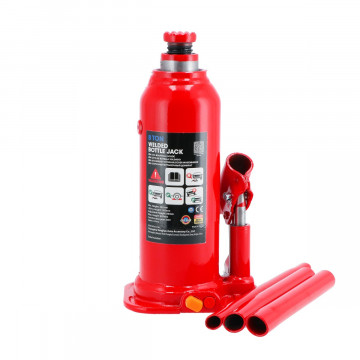
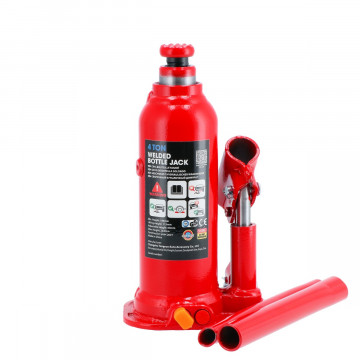
Bottle jack
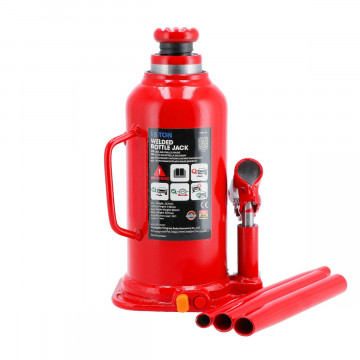
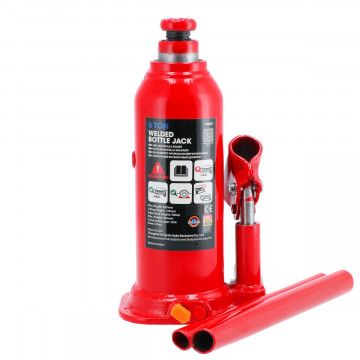
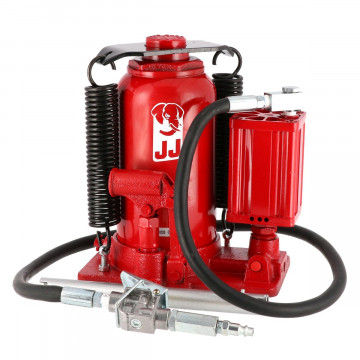
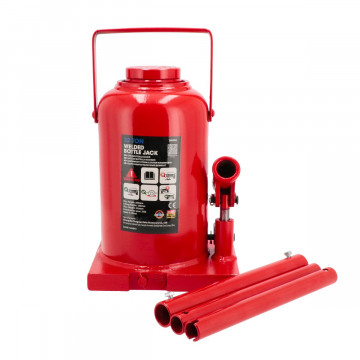
The hydraulic bottle jack is designed to lift vehicles, such as cars or caravans. Powered entirely by a hydraulic system, this workshop equipment is easy to use with a telescopic handle. There are two types of bottle jacks: manual and air-powered ones. If you opt for an air-powered bottle jack, ensure that the air compressor you use is strong enough to operate it.
The advantage of bottle jacks is that they're more compact and lighter than garage jacks, making them perfect for storing in a car boot for on-the-go use. While the bottle jack can easily lift your vehicle, it is important to note that it is not meant to support the vehicle for long periods. After lifting, always use car jack stands to stabilize the vehicle and enhance safety.
The hydraulic bottle jack works using a hydraulic piston that rises when the oil inside the jack is pressurized. To pressurize the oil, simply operate a lever manually or with compressed air via an air compressor (some jacks may have both options). If using an air bottle jack, ensure that the compressor has compatible specifications.
When using this type of lifting jack, it is important to place it on a flat surface to make the support as stable as possible, without the risk of tipping. Also, don't forget to add car jack stands for added safety. By operating the lever up and down or by pumping air into it, the jack will lift the vehicle beneath it.
When you wish to lower the vehicle, you will need to slightly unscrew the release valve using one part of the lever so that the air can escape and the pressure decreases. The vehicle will lower smoothly and safely thanks to the hydraulic function. Important: Even though the valve is fitted with an O-ring to prevent oil from leaking, be careful not to unscrew the valve too much! This could lead to oil loss, which could affect the jack's proper operation.
All Airpress bottle jacks are single-stage jacks, made of steel and featuring overload protection. Additionally, they are easy to transport thanks to their functional handles.

What should I consider when buying a bottle jack?
There are a few things to consider when buying a bottle jack. First, the weight to be lifted (lifting capacity) can range from 4,000 to 30,000 kg, so the choice of jack depends on your needs. For example, with a 4,000 kg lifting capacity jack, you will be able to lift a car or caravan. However, to lift a truck, you will need a more durable jack with a minimum lifting capacity of 10,000 kg (adjusted based on your vehicle).
Don't forget to consider the lifting height, as it needs to be adjusted according to the height of your vehicle. Some vehicles are taller than others, so the jack must be able to fit properly underneath.
Another important, yet often overlooked, point is the weight of the bottle jack itself. Airpress bottle jacks range in weight from 3.7 to 22.3 kg. Heavier models are intended to stay in an automotive garage, while lighter models are preferred for regular transport.
The last point is the actual use of the bottle jack. Like most jacks, they are designed only to lift the car. Once the desired height is reached, it is necessary to stabilize the vehicle with car jack stands. They ensure that, in the case of jack failure and sudden falling, the vehicle will not fall violently and will remain supported.
How to maintain a hydraulic bottle jack?
All Airpress bottle jacks use a hydraulic piston. For the piston to function, it requires hydraulic oil, which, when pressurized, allows the movable part of the jack to lift and lower.
As with all oil-lubricated tools, it is necessary to regularly check the oil level and, when needed, add or drain it. During maintenance, also check that the piston oil chamber is free from debris or dust, which could cause problems.
My bottle jack doesn't lift or lower
It can happen that a bottle jack doesn't work properly, and this can be for several reasons.
Firstly, there might be too much or too little oil. If the hydraulic piston of the jack does not lift or can't support the load once raised, it is due to insufficient oil in the reservoir. On the other hand, if the jack refuses to lower, it is often because there is too much oil.
Secondly, air could be trapped in the system, preventing the piston from lifting or lowering. You can release the air at the purge valve.
Finally, consider the weight of the vehicle being lifted. If you overestimate the lifting capacity of the jack, the piston will not be able to lift the vehicle. If that's the case, use a jack with a higher lifting capacity. Warning: Lifting a vehicle too heavy for the jack's capacity can result in serious accidents, as the jack can fall at any time due to weight overload.